Powertrain Essentials: Engines, Remanufacturing, and Block Manufacturing Solutions
Walk into any automotive plant—whether it’s a high-volume OEM facility or a mid-scale supplier unit—and one thing becomes clear very quickly: the powertrain still drives the business.
Not just in terms of motion, but in terms of cost, failure risk, and long-term value.
Even today, in a time of so much hype around EVs, production lines worldwide are still heavily committed to Automotive Powertrain Systems based on gas or diesel fueled internal combustion engines. Because of that, the actual discussion in the industry has changed. It’s no longer “new vs. old.” It’s about how to make existing systems work harder, last longer, and cost less over time.
The Pressure Is Not on Design Alone Anymore
A decade ago, most talks about engines were almost entirely about performance — how much power they make, their fuel economy, emissions.
That impulse never left, but it’s not enough now.
| Also Read: Why B2B Customers Choose Remanufactured Engines? |
Today, when teams refer to Powertrain Engineering Solutions, they might also be thinking of:
- machining repeatability
- scrap rates
- rebuild cycles
- field failures
Because that’s where the actual money is either saved or lost.
A finely engineered, hard-to-construct or costly to refurbish power plant soon becomes a ball and chain.
| Also Read: Types of Automotive Engines: Gasoline, Diesel, Hybrid & Electric |
Under the Hood: Small Mistakes, Huge Headaches
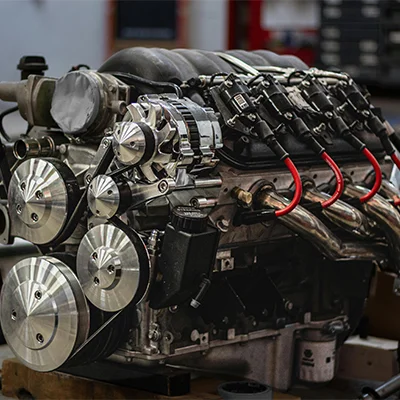
Automotive Engine Components look fairly simple on paper — pistons, crankshafts, cylinder heads, valves.
In practice, however, these components operate under conditions of stress with little margin for error.
Internal combustion engine parts, e.g. Piston rings, cylinder liners. A micron-level difference when making that might not be visible right away. But after a few hundred hours of operation, it can lead to wear patterns that reduce efficiency or increase oil consumption.
This is why experienced manufacturers don’t just rely on final inspection anymore. They watch the process itself.
| Also Read: Choosing a Reliable Engine Block Manufacturer for OEM or Aftermarket Needs |
Manufacturing Reality: It’s a Control Problem
Most suppliers today already have access to CNC systems and automation. That’s not the differentiator anymore.
The real challenge in Engine Manufacturing Solutions is consistency over time.
Can your line produce the same quality on Monday morning and Friday night?
Can you maintain tolerance when tool wear starts creeping in?
That’s where Precision engine manufacturing becomes less about machines and more about discipline.
In many facilities, operators now rely on in-line measurement systems during Cylinder block machining. Not because inspection is new—but because waiting until the end is too late.
When a defect is visible, the cost has already grown exponentially.
Cylinder Blocks: The Part Nobody Can Afford to Get Wrong
Ask anyone on the shop floor, and they’ll tell you—the cylinder block is where things either go right or go very wrong.
Everything depends on it. Alignment, sealing, thermal behavior.
Working on Cylinder block manufacturing solutions for engines isn’t just about getting the casting right. It’s about managing what happens after casting:
- how the material reacts during machining
- how heat treatment affects distortion
- how tolerances stack up across multiple operations
Some manufacturers have started combining casting and machining under tighter process control loops. Not because it sounds advanced—but because it reduces surprises.
And in production, fewer surprises usually mean better margins.
Remanufacturing: Not a Backup Plan Anymore
There was a time when Engine Remanufacturing Services were treated as a fallback—something to consider only when budgets were tight.
That thinking doesn’t hold up anymore.
Nowadays, remanufacturing tends to be planned from the beginning. And particularly in tough-on-the-gear industries — construction, mining, logistics.
Why? Because replacing engines repeatedly doesn’t scale well.
What Actually Happens in Remanufacturing (Beyond the Brochure)
The Engine remanufacturing process in automotive industry sounds clean when described in steps—disassemble, clean, inspect, rebuild.
In reality, it’s more judgment-driven than that.
Not every component follows a fixed path. Some parts look acceptable but fail under testing. Others appear worn but can be restored using newer Engine rebuilding technologies.
For example, surface restoration techniques now allow certain components to be reused instead of scrapped. That wasn’t always possible earlier.
So the process is not just technical—it’s selective. And that’s where experience matters.
Why Businesses Are Leaning Toward Remanufacturing
At some point, every fleet operator or industrial buyer does the math.
A brand-new engine comes with high upfront cost and longer wait times. A remanufactured one—if done properly—can deliver similar performance at a lower cost and faster turnaround.
That’s where Cost-effective engine remanufacturing services are gaining ground.
And it is not only about saving money. It is of operations that can be carried on without failure in a long run.
Downtime, after all, costs more than the engine in many cases.
The Overlooked Part: Integration with the Drivetrain
One mistake companies sometimes make is looking at engines in isolation.
But in reality, performance depends on how well the engine works within Automotive drivetrain systems.
The delivery of torque, the handling of loads, the efficiency of it all depends on the way the engine interfaces with the transmission and subsequent parts.
This is why increasing numbers of teams are now taking a step back and analyzing the entire system, instead of streamlining individual aspects of the system.
Choosing Between New and Remanufactured: It’s Situational
There’s no universal rule here.
New engines make sense in some cases—new platforms, higher performance requirements, or stricter compliance needs.
But in many day-to-day operations, remanufacturing offers a more practical route.
What’s interesting is that companies are no longer choosing one over the other. They’re combining both:
- using Engine Manufacturing Solutions for new builds
- relying on remanufacturing for lifecycle management
It’s less about preference and more about fit.
Where Things Are Heading
Despite all the talk about disruption, the shift in powertrain isn’t happening overnight.
Instead, it’s happening in layers.
Better machining.
Smarter rebuild processes.
Improved material handling.
All of this feeds into what we now call Advanced powertrain systems for automotive applications.
It’s not one giant leap — it’s a bunch of incremental, useful changes.
Final Thought
If there’s one thing that stands out across the industry right now, it’s this:
The companies doing well are not necessarily the ones with the most advanced designs. They’re the ones managing the full lifecycle better.
From Cylinder block machining to Engine Remanufacturing Services, every stage matters.
Because in the end, powertrain performance is not decided only at the design table.
It’s decided on the shop floor, in service bays, and in how well businesses balance cost, quality, and time—again and again. Inside the Engine: Little Errors, Big Problems
 Media Pack Download
 Newsletters
 Industrial Events