
Materials Enabling Effective Thermal Management in Electric Vehicles
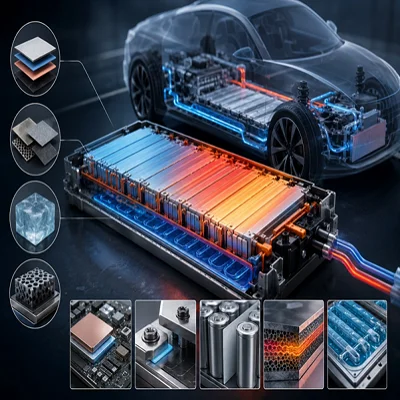
In the perspective of talking about electric cars, most of the conversations still revolve around the range issue, charging rate, and battery technology. Those are visible metrics.
What’s less visible—but just as decisive—is how heat is handled inside the vehicle.
Not in a broad “cooling system” sense, but at a much deeper level: how heat moves through materials, where it gets trapped, and how quickly it can be redirected.
That’s where EV thermal management materials have quietly become a core engineering focus. Not as supporting elements, but as enablers of performance, safety, and long-term reliability.
Heat in EVs Isn’t Constant—and that’s the Real Problem
If heat were steady, managing it would be simpler. However, EVs do not act so.
It can switch within minutes between relatively steady and thermally stressed battery packs, and can be triggered by fast charging, road rage, or even ambient temperature changes. It is not simply a matter of getting the heat out, but rather it is a matter of having to deal with uneven, unpredictable spikes.
This is why battery thermal management in EVs is less about “cooling” and more about control.
Engineers are trying to keep thousands of individual cells operating within a narrow band, without letting one section drift too far from the rest. Once that balance is lost, performance drops quietly—and sometimes permanently.
Cooling Systems Alone Don’t Solve It
Yes, the electric vehicle cooling systems today were much more advanced than they were some years ago. Liquid cooling loops, stream-lined airflow, built-in heat exchangers, it all makes part of it.
However, this is the truth: even the most designed system will not be as good as it could be when the materials within it do not co-operate.
Heat doesn’t move efficiently just because a cooling channel exists. It needs pathways. It needs continuity. And most importantly, it needs the right interfaces.
That’s where material science starts doing the heavy lifting.
The Quiet Role of Thermal Interface Materials
There’s a reason thermal interface materials (TIMs) keep coming up in design discussions—they solve a problem that’s easy to miss.
Two solid surfaces rarely touch as perfectly as they appear to. At a microscopic level, there are gaps. And the holes hold air, a bad conductor of heat.
TIMs step in to eliminate that barrier.
They sit between components—battery cells and cooling plates, power devices and heat sinks—and make sure heat actually transfers instead of getting stuck.
The only thing that has changed in the recent times is the extent of customization that these materials have undergone. No longer is it a one type fits all scenario. Engineers now select TIMs based on:
- Surface irregularity
- Pressure conditions
- Thermal load variability
It’s a small layer, but it often determines whether a system performs as expected—or not.
Phase Change Materials and the Problem of Sudden Heat
Some thermal issues aren’t gradual. They spike.
Fast charging is a good example. So is rapid acceleration. In these moments, traditional cooling systems can lag slightly behind the heat being generated.
That gap is where phase change materials (PCMs) prove useful.
PCMs absorb heat instead of dissipating it on the spot. They behave as a short-term buffer, where thermal energy is stored during times of peak demand, and is then released in the future.
Realistically, they even out the variation of temperatures. And that directly affects the optimization of EV performance, particularly in a situation where consistency is more important than the raw output.
Lightweight Materials Are Now Doing Double Duty
Reducing weight has always been a priority in EV design. Less weight means better efficiency—it’s that simple.
But the expectation from materials has evolved.
Today’s lightweight materials for efficient heat dissipation in EVs are expected to do two things at once: reduce mass and actively contribute to thermal control.
That’s why we’re seeing increased use of:
- Aluminum-based composites
- Graphite-enhanced structures
- Thermally conductive polymers
These materials aren’t just structural anymore. They’re part of the thermal pathway.
And in compact EV architectures, that dual function is becoming essential.
Safety Is Driving Some of the Most Important Material Choices
Thermal management isn’t just about performance—it’s closely tied to safety.
When a battery cell overheats, the real risk isn’t the single cell. It’s what happens next. In cases where the heat radiates to other cells, the circumstances get out of control.
It is at that point that high-performance materials come in.
Instead of focusing only on heat removal, these materials are designed to slow things down:
- Flame-retardant polymers delay ignition
- Ceramic barriers resist extreme temperatures
- Aerogels limit heat transfer between cells
In effect, they buy time. And in thermal events, time is critical for maintaining battery safety & performance.
Liquid Cooling Works—But Materials Make It Reliable
Liquid cooling continues to dominate in high-performance EVs for a reason—it’s efficient.
But efficiency on paper doesn’t always translate to real-world durability.
Coolants can degrade materials. Seals can weaken. Corrosion can build up over time.
That’s why material selection inside battery cooling systems is becoming more strategic. It’s not just about thermal conductivity anymore. It’s about:
- Chemical compatibility
- Long-term stability
- Resistance to wear
The lack of the latter renders even highly designed structures ineffective with time.
Air Cooling Is Not Dead - It Just Is More Selective.
Air cooling is often scorned; nevertheless, it has its application- in smaller or more economical EVs.
The only difference is that this time around it is being backed in a way that has never been witnessed before.
Engineers are not simply using airflow since they are combining it with other materials that help to evenly distribute heat. These systems are becoming viable in ways that they have never been.
They might not be as effective as liquid cooling, yet they allow small and lightweight solutions in which simplicity is a key consideration.
A Rapid Immersion Cooling Note
One of the more discussed developments at the moment is immersion cooling. It seems easy to submerge battery cells in dielectric fluid, yet this brings a new dimension of complexity.
Materials must now be able to resist continuous exposure to chemicals, not only heat.
That changes the selection criteria entirely.
Only certain advanced materials for EV batteries can handle that environment without degrading. And until those materials are widely scalable, immersion cooling will remain limited to specific applications.
Where Real Progress Is Happing
If there’s one pattern across the industry, it’s this: no single solution is enough.
The real gains are coming from combining approaches.
A typical system today might use:
- TIMs for efficient heat transfer
- PCMs for thermal buffering
- Structural materials for heat distribution
Together, these form layered heat dissipation technologies that handle both steady-state and peak conditions more effectively.
Why This Matters for the Industry
For suppliers and OEMs, thermal management is no longer just a technical detail—it’s a performance differentiator.
Better materials directly influence:
- Charging speed
- Battery lifespan
- System reliability
And in a competitive market, those factors are hard to ignore.
The companies that treat thermal management solutions for electric vehicles as a materials challenge—not just a mechanical one—are the ones moving ahead.
Final Thought
EV development has frequently been framed in terms of breakthroughs, such as new chemistries, new architectures, and new technologies.
However in most instances, development is occurring in less overt forms.
Better interfaces. Smarter materials. More thoughtful integration.
That’s what’s enabling the next level of performance.
And as EVs continue to evolve, the role of materials won’t just grow—it will define how far the technology can go.
 Media Pack Download
 Newsletters
 Industrial Events