Accelerating Automotive Production: AI and Digital Twins Drive 2025 Efficiency
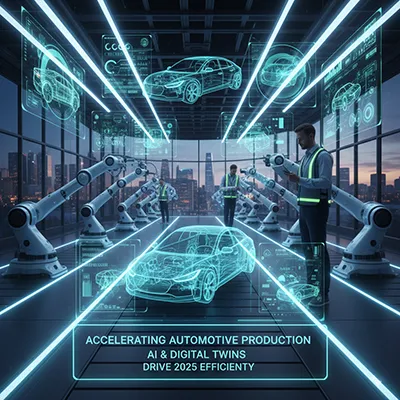
The automotive industry is experiencing a seismic shift, driven by a quickly adopted technology and the necessity of efficiency in an electric vehicles (EVs), supply chain disruption, and sustainability environment demand era. With the world production goals on the rise (projections indicate more than 100 million vehicles within the industry by 2030), the conventional means of manufacturing are being replaced by AI in car manufacturing and the digital twin in the automotive sector. The Automotive Industry 4.0 is based on these innovations that make automotive production optimizable with AI and allow smart technologies in the manufacturing processes. By 2025, digital twins, or virtual replicas of physical objects, and AI will not be a tool; it will be the driver of the highest level of efficiency ever, decreased downtime, cost reduction, and time-to-market.
The emergence of Digital Twins and AI in the current factories.
Central to this change are the so-called digital twin, a high-fidelity virtual representation of real-life automobiles, assembly lines, and factories, which is updated in real-time. Combined with machine learning in the vehicle production industry, digital twins can simulate virtually in the automotive design, and engineers can test prototypes without creating them physically. This online thread and virtual modeling technique generates an uninterrupted data stream between design and production and builds interconnected manufacturing systems.
This is further enhanced by AI-based production optimization, which processes the huge datasets of sensors and IoT tools. In smart automation of factories, AI algorithms preempt bottlenecks, streamline the workflow, and allow independent production lines. As an example, AI-driven real-time production analytics can track assembly speeds, material movement, and human interactions, changing parameters dynamically in order to keep production processes as efficient as possible. This is the synergy that is characteristic of the automotive digital transformation where factories transform into ecosystems that are flexible.
The best case example is the Gig factories of Tesla, where digital twins model entire production lines, incorporating automotive data integration in all locations around the world. Through AI, Tesla has reached AI quality control, with computer vision inspecting welds and being able to inspect parts at rates that humans cannot, and minimized defects by up to 30%.
Predictive Maintenance: Down-time Reduction in the Car Factories.
Predictive maintenance in car factories is also one of the most significant applications because AI can foresee the failure of equipment even before it happens. Traditional reactive maintenance results in expensive halts - manufactures can pay millions of dollars per hour in downtime. Digital twins (replicates of machinery behavior) are added together with machine learning models (trained on past data).
AI uses real-time production analytics to track vibration, temperature variations, and robotic arm wear. When anomalies occur, preemptive repairs are triggered by the system, which further increases the life cycle of the assets and uptime. BMW, a smart manufacturing leader in the automotive industry, applies digital twins to its iX EV line with the help of AI predicting failures at the conveyor belt with 95 percent accuracy. Not only does this AI in the automotive manufacturing industry reduce the maintenance expenses by 20-40 percent but also becomes connected to the connected manufacturing systems to coordinate suppliers flawlessly.
In autonomous production lines, AI will go further to an optimization of the workforce by dynamically scheduling human-robot work. Machine learning of vehicle manufacturing optimizes these forecasts with time, an attribution of each intervention and improves digital thread continuity.
Quality Control and Virtual Simulation: Accuracy on Scale.
Defect detection is being transformed by AI-based quality control. Conventional checks are based on manual inspections, which are likely to be subject to human error. Out of virtual simulation in car design, AI uses deep learning to scan parts using cameras and LiDAR cameras to detect micro-flaws in paint, welds, or battery cells. This will be essential in 2025, when the EV manufacturing increases, and the battery integrity and safety standards should be met.
Highly automated factories of Ford are the leaders in intelligent automation of factories, with digital twins being used to simulate crash tests and assembly steps virtually and cutting the need to physically prototype by half. The production analytics is fed into such models in real-time, which allows ongoing improvements. The automotive industry version of the digital twins approach helps to optimize production using AI, alerting quality concerns at the initial level and stopping production wastes in autonomous manufacturing lines.
Besides, these insights are carried by automotive data integration between various sources, such as ERP systems, supply chains, and sensors. Machine learning algorithms handle petabytes of data, discover the trends that cannot be perceived with the naked eye, and therefore propel the Automotive Industry 4.0.
Case Studies Automotive Digital Transformation Wins.
Major OEMs are already enjoying fruits. The MEB platform of Volkswagen EVs is a digital twin; optimization of battery production is provided with the help of which predictive maintenance is implemented in car factories and AI is exercised to provide a 99.9% uptime. Their networked production networks connect plants on different continents and provide instantaneous production analytics, which adapt to supply shocks, such as semiconductor shortages.
General Motors (GM) also uses machine learning to manufacture its Ultium battery technology in vehicle manufacturing through virtual simulation of design, which reduced years of development to several months and quality control through AI-assistance, which has zero-tolerance toward defects. GM records a 25 efficiency increase, which is driven by smart manufacturing in automotive and digital thread and virtual modeling.
Toyota Society 5.0 vision brings AI into the automotive production in Asia in autonomous manufacturing production lines, whereby the robots ultimately self-adapt on the basis of integrating automotive data. These instances emphasize the fact that digital twins within the automotive sector and AI are scalable, adaptive, and significant in the automotive digital transformation.
Difficulties and the Way to Go.
The challenge has obstacles even after the promise. There are data silos that hamper automotive data integration and the cyber security threats are huge in the connected manufacturing systems. Digital twins and AI infrastructure are expensive to start with, and small players are scared off, and intelligent factory automation has skill shortages that need up skilling workforces.
Production optimization is required to be strong on AI-driven regulatory compliance, particularly of EVs that are compliant with standards such as ISO 26262. Another frontier is the ethical use of AI, i.e. machine learning that is impartial in the vehicle manufacturing. The options are hybrid cloud-edge computing to provide safe real-time manufacturing analytics and cooperation with technological giants such as Siemens or NVIDIA to obtain available tools.
Investing in Automotive Industry 4.0 is booming even looking forward to 2025, with McKinsey estimating that digital twins alone can bring a value of 300 billion. Governments through incentives such as U.S. CHIPS Act are speeding up adoption.
Conclusion: A Hyper-Efficient Future in the Future.
The use of AI and digital twins to accelerate production in the automotive industry is no longer a futuristic move but is the new reality that propels efficiency in auto production in 2025. Predictive maintenance in car factories, AI-driven quality control and virtual simulation in automotive design are examples of the technology that can be used to achieve smart manufacturing in the automotive sector on a massive scale. Through adopting digital twins in the car market, autonomous manufacturing lines, and linked manufacturing systems, the industry will be able to overcome the challenges such as EV changes and geopolitical tensions.
The digital transformation of the automotive business does not only portend cost-saving but long-term and sustainable operations. Machine learning in the development of vehicles will continue to transform, and with more integration of digital thread and virtual modeling in vehicle development, make a further leap towards zero-waste, hyper-connected factories. To automakers willing to invest, the year 2025 will not be a problem, it will be an opportunity to be the best.
 Media Pack Download
 Newsletters
 Industrial Events